
Guide · Plasma torches
How does a plasma torch work?
A plasma torch turns electricity into a jet of gas hotter than 3,000°C. Here is how it makes and holds the arc, how the main technologies differ, and where industry uses it.
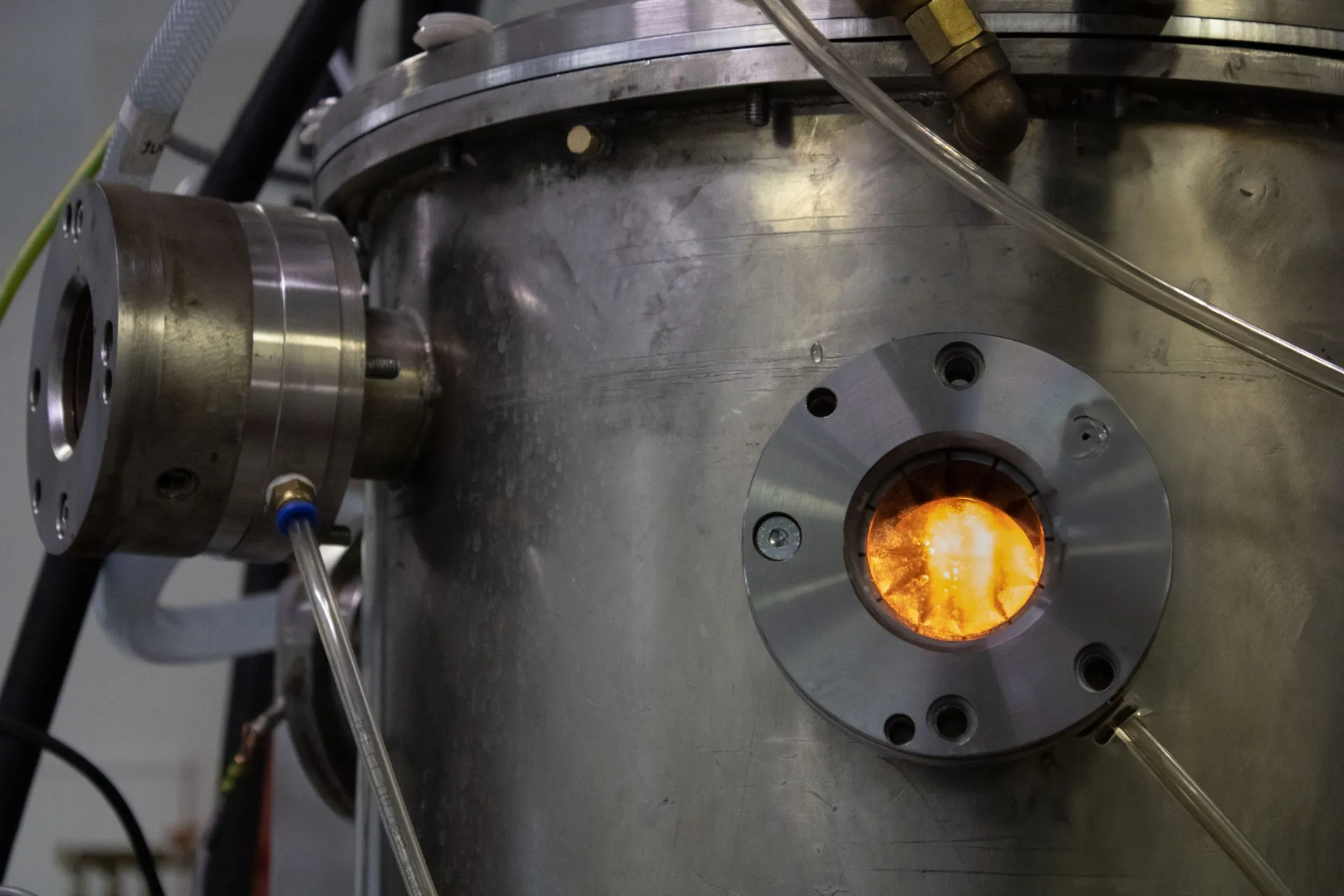
The short answer
A plasma torch passes an electric current through a gas until the gas becomes plasma.
- The current ionises the gas: electrons are torn from its atoms and the gas starts to conduct electricity like a metal.
- An electric arc keeps that plasma going and heats it to thousands of degrees; the gas flow carries the heat into a furnace or reactor.
- There is no flame and no combustion, so the heat itself emits no CO₂: it is electric heat.
- Torches differ in how they make the plasma: direct-current arc, alternating-current arc, radio frequency or microwaves.
What is plasma?
The fourth state of matter.
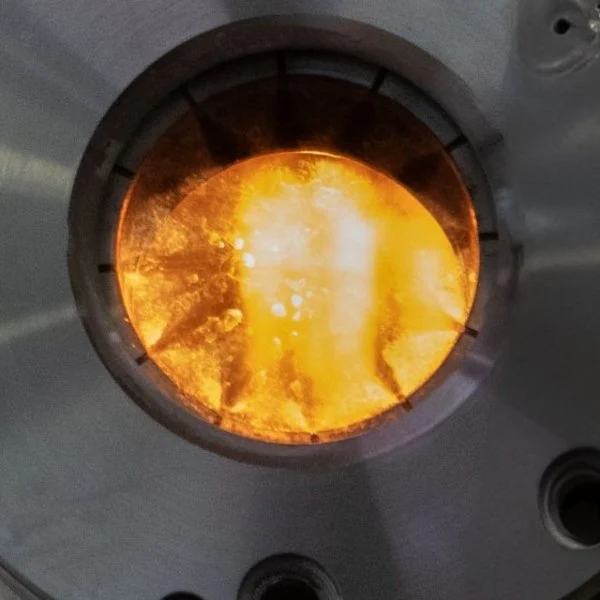
Heat a solid and it melts; heat the liquid and it boils. Push a gas further, with very high temperature or a strong electric field, and its atoms start to lose electrons. The gas becomes a mixture of free electrons, positive ions and neutral particles: a plasma.
Because it carries free charges, a plasma conducts electricity and reacts strongly to electric and magnetic fields, yet it stays electrically neutral overall. The sun, lightning and the aurora are natural plasmas; most of the visible matter in the universe is in this state, but on Earth plasma has to be made.
Thermal (hot) plasma
Electrons and heavy particles share the same very high temperature (local thermodynamic equilibrium) and the gas is strongly ionised. This is the plasma of industrial torches: it delivers heat for melting, cracking molecules and high-temperature chemistry.
Cold plasma
Only the electrons are hot; the heavier particles stay close to room temperature and the gas is weakly ionised. Cold plasmas treat surfaces, sterilise and etch electronics, but they do not carry enough heat for heavy industry.
Step by step
How a plasma torch makes heat.
1
Gas in
A plasma gas flows between the electrodes: nitrogen, argon or air, or a process gas such as methane, hydrogen or CO₂.
2
The arc strikes
A high voltage across the electrodes breaks the gas down; an electric arc forms and the gas in its path becomes plasma.
3
Heat builds up
The current flowing through the arc heats the plasma to thousands of degrees, far above any fuel flame.
4
Heat goes to work
The gas flow carries the hot plasma out of the torch into the furnace, gasifier or reactor where the process takes place.
Once there, a thermal plasma acts in three ways at once: thermal (it brings intense heat), chemical (its free radicals speed up reactions) and hydrodynamic (it stirs and mixes the gas around it).
Technologies
The four main types of plasma torches.
All thermal plasma torches turn electricity into heat; they differ in how they couple the power into the gas.
DC arc torch
Two electrodes, often concentric rings, act as cathode and anode. An external magnetic field usually spins the arc so the electrodes wear evenly. Plasma cutters are small DC torches whose arc closes on the metal being cut.
Needs: an AC/DC rectifier; usually a stop to replace worn electrodes.
AC arc torch
The electrodes are fed with alternating current, most often three electrodes on a three-phase supply. The arc jumps between each pair of electrodes and stabilises itself, with no rectifier and no external magnetic field.
Electrodes: metal (tungsten) or graphite.
Radio-frequency (ICP) torch
A coil driven at a few megahertz induces the plasma inside a confinement tube, without electrodes in contact with the gas, which keeps the plasma very pure.
Typical uses: powder spheroidisation, nanomaterials.
Microwave torch
Microwaves at gigahertz frequencies travel along a waveguide and pass their energy to the electrons of the gas. Some designs need an igniter to start and stabilise the plasma.
Typical uses: laboratory and chemical processes.
DC or AC?
Arc torches: direct current versus three-phase alternating current.
| DC arc torch | Three-phase AC arc torch | |
|---|---|---|
| Power supply | Needs an AC/DC rectifier, with its cost and conversion losses. | Runs on the grid frequency (50 or 60 Hz) through a transformer: no rectifier. |
| Arc stability | An external magnetic field guides and spins the arc. | Self-stabilised: the arc moves between the three electrode pairs by itself. |
| Electrode wear | Cathode and anode wear differently. | Each electrode is in turn cathode, anode and at rest, so the three wear evenly. |
| Electrode replacement | The torch is shut down, sometimes partly dismantled. | With moving electrodes and an automatic feed, new electrodes go in while the torch runs. |
| Gas velocity | Usually needs a high gas flow to push the arc. | Works over a wide range, down to very low gas velocity: useful when a reaction needs a long residence time. |
Inside a three-phase AC torch
Three electrodes, 300 arcs a second.
In the Plenesys' torch, three graphite electrodes meet near a central point, each connected to one phase of the grid supply. At 50 Hz the arc jumps between the electrode pairs 300 times a second, so each arc lives about 3 milliseconds: enough to pass its power to the gas flowing through, which reaches several thousand degrees.
Graphite sublimes only at around 4,000°C, above the melting point of any metal, so the electrodes need no direct water cooling. Less heat is lost to cooling water, and thermal efficiency reaches 90–95%.
The electrodes wear as they work. A camera and image-recognition software watch the electrode tips, the control system keeps the gap between them at the right distance, and the TRX electrode-holders feed new graphite in without stopping the plasma.
300
Arcs per second
at 50 Hz: three electrodes, three phases
≈3 ms
Life of each arc
before it jumps to the next pair
3,000°C+
Arc temperature
electric heat, no combustion
90–95%
Thermal efficiency
graphite electrodes, no direct water cooling
See it in 3D
Drag to explore the torch.
The three TRX electrode-holders sit around the torch bell; each one feeds its graphite electrode towards the arc.
Applications
Where plasma torches are used.
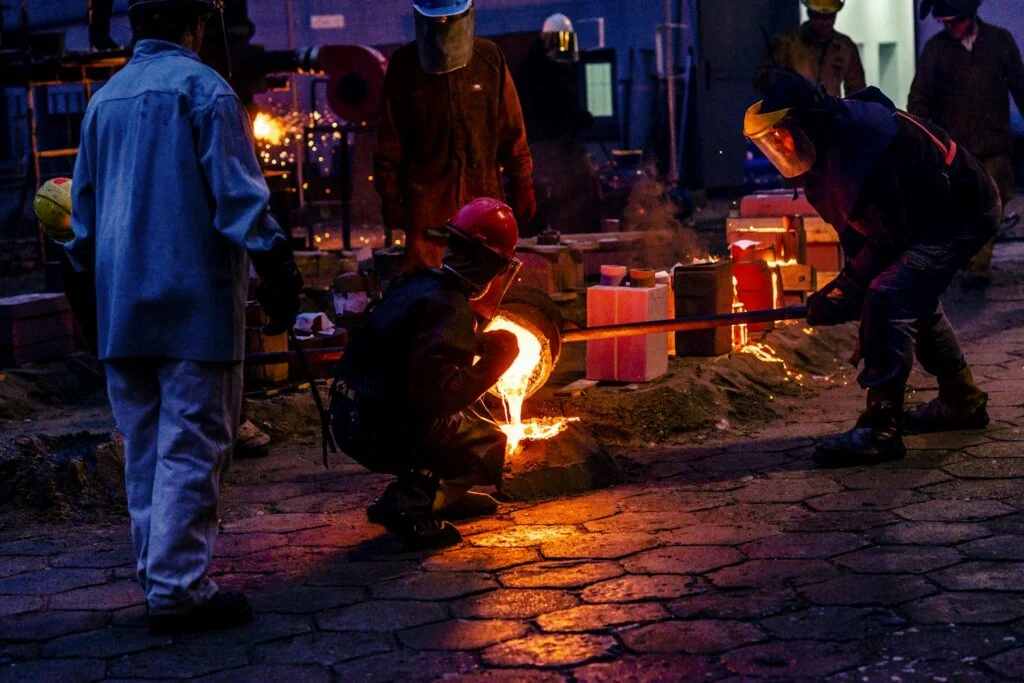
Steel, aluminium and cement
Electric high-temperature heat that replaces fossil burners in furnaces and kilns.
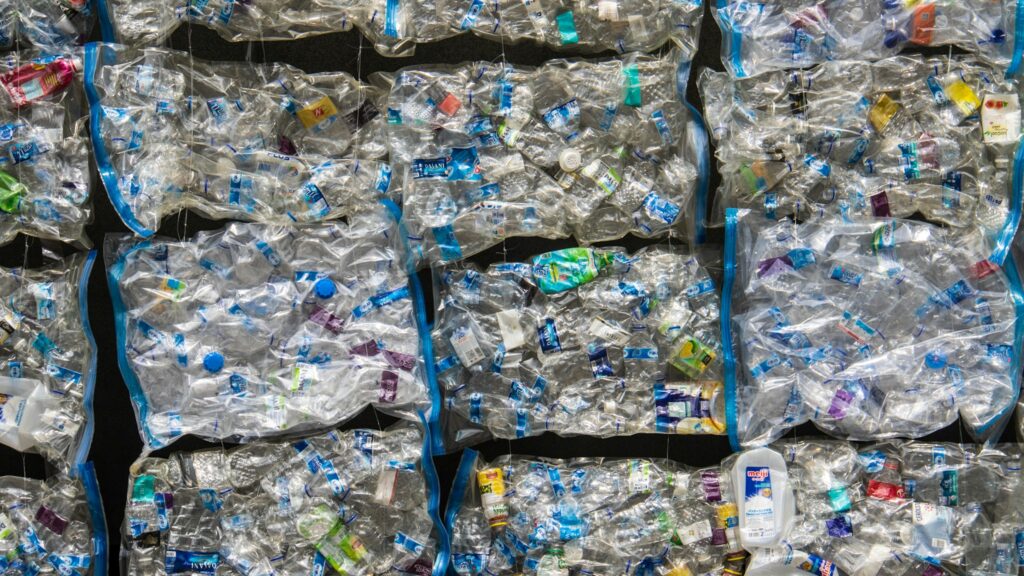
Waste treatment
Gasification into syngas, vitrification of hazardous residues and destruction of chemical waste.
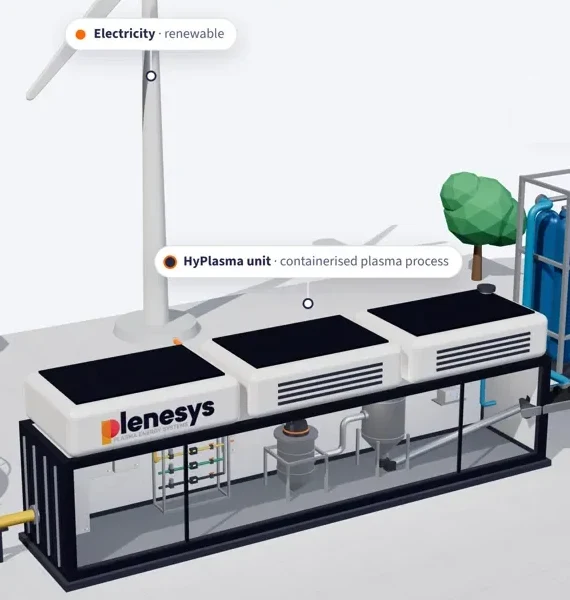
Hydrogen and carbon
Methane pyrolysis: the plasma splits methane into hydrogen and solid carbon, with no direct CO₂.
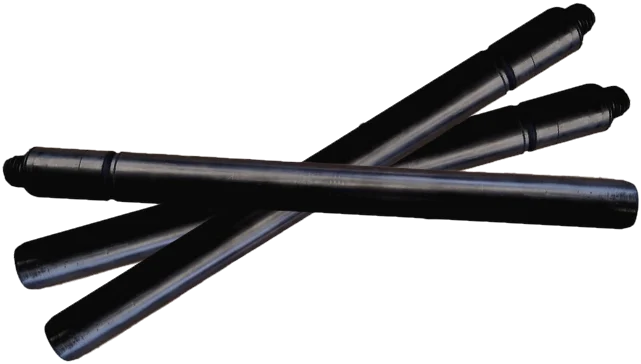
Metal powders and chemistry
Spheroidisation of high-melting metals such as titanium, nickel or tungsten for 3D printing, and high-temperature synthesis.
Questions
Frequently asked questions
How hot is a plasma torch?
The arc of a Plenesys torch is above 3,000°C, and the core of an electric arc is hotter still. That is well beyond the temperature of a fuel flame, which is why plasma can drive reactions that ordinary heating cannot.
Does a plasma torch emit CO₂?
Not directly: it burns nothing, it turns electricity into heat. Its overall footprint depends on how the electricity is produced, which is why plasma pairs well with low-carbon and renewable power.
Which gases can a plasma torch use?
Gases such as nitrogen, argon or air, and process gases such as H₂, CO, CO₂ or CH₄. The Plenesys' three-phase torches also accept streams carrying solid particles.
Is a plasma torch the same as a plasma cutter?
They share the principle. A plasma cutter is a small DC torch whose arc melts and blows away metal. An industrial plasma torch supplies heat to a process continuously, from tens of kilowatts to several megawatts.
How efficient is an industrial plasma torch?
It depends on the design and on how much heat goes into electrode cooling. The Plenesys' three-phase torches reach 90–95% thermal efficiency, helped by graphite electrodes that need no direct water cooling.
What happens when the electrodes wear out?
In most arc torches the process has to stop while the electrodes are changed. In the Plenesys' torch, the TRX electrode-holders feed new graphite electrodes in while the plasma keeps running.
Electric heat for your process?
Tell us about your furnace, reactor or gas: our engineers will tell you what a plasma torch can do for it. Next guide: what is methane pyrolysis?